Not every booking starts with a click on the booking page. Company events, room rentals or workshops often start with a question. Under Inquiries, anny collects all of these requests in one place: from your inquiry forms, from forwarded emails and from your AI assistants. You reply straight from anny, propose bookings and send a quote your customers accept online.
In anny, every inquiry is an order with an Inquiry status. Everything that belongs to the inquiry stays together: the customer, the form answers, the email conversation, bookings, invoice and quotes.
Admin 3.0 beta (as of October 5). Changes are possible.
How do inquiries reach anny?
The inquiries overview
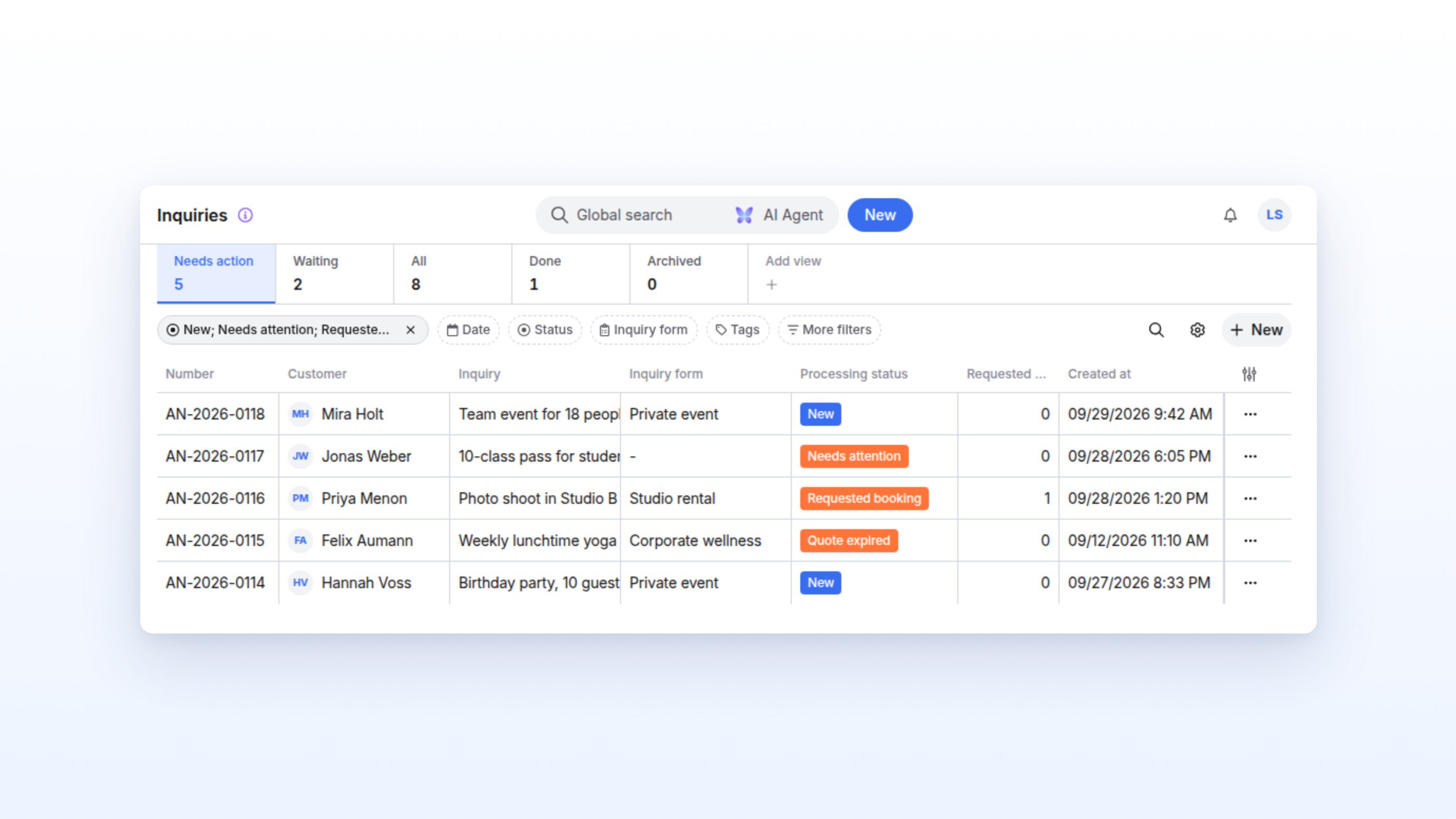
You find the inquiries in the sidebar under Management → Inquiries.
At the top you pick a view. The number below its name shows how many inquiries it holds.
The table shows columns such as Inquiry (the request or a summary of the email), Inquiry form, Processing status and Requested bookings. Use the Inquiry status filter to narrow the list further. Manage inquiry forms in the toolbar takes you straight to your forms.
Click a row to open the inquiry in a side panel. Use the arrows at the top of the panel to jump to the previous or next inquiry.
Inquiry status
You usually don’t need to maintain the status yourself. anny sets it automatically as soon as something happens:
Inquiries are not assigned to anyone. If a specific person should take care of one, create a to-do in the activity log and assign it. Learn more in Activity log. Working on an inquiry
The side panel shows the inquiry details on the left and the activity log on the right.
- Summary: inquiry status, requested bookings, customer and the request.
- Form responses: the Channel the inquiry came through (for example Website form or Voice assistant), when it was submitted, which Inquiry form was used and all answers.
- Bookings, Products, Invoices and further sections as on every order.
Replying
Write the customer an email directly in the activity log on the right. The inquiry then moves to Waiting. When the customer replies, the email lands in the activity log, your team is notified and the inquiry moves to Needs attention. How to write emails and add notes is explained in Activity log.
If the inquiry arrived without a customer, for example from a forwarded email, click Add customer in the Summary.
Accepting or rejecting requested bookings
If the customer requested bookings that you need to approve, the Summary shows the Requested bookings row. Click Accept bookings or Reject bookings there. Once all requested bookings are decided, the inquiry moves to Done.
Proposing bookings
To propose a date to the customer without blocking the resource, create a transparent booking. In the calendar, complete a booking on this order with the Transparent bookings option. Transparent bookings occupy no capacity, and the resource stays bookable for others.
If an inquiry names an unambiguous date together with a resource and service, anny creates such a booking proposal automatically. Check it before you confirm it or include it in a quote.
To book a proposal for real, choose Confirm booking on the booking. anny checks availability, confirms the booking and occupies the capacity from then on. With Email a confirmation to the customer, you let the customer know right away.
Sending a quote
Check the draft invoice
Open the Invoices section of the inquiry. Check the Draft invoice with all bookings and products.Use Create quote to preview the quote as a PDF.
Prepare the quote
Click Send as quote.anny creates the quote PDF and opens a window for sending it.
Set the email and validity
Check Recipient, Subject and the message. Under Valid until, set how long the customer can accept the quote. The default is 14 days.The date is printed on the quote.
Reserve bookings (optional)
Turn on Reserve bookings if the proposed bookings should block their slots as soon as the quote is sent. With Expire bookings when the quote expires, they free any held slots again if the quote isn’t signed in time.Transparent bookings become booking proposals when the quote is sent.
Send
Send the quote.The customer receives the quote by email with a button to accept and sign it online. The inquiry moves to Quote sent.
If Reserve bookings is on and a slot is no longer free, anny does not send the quote. Adjust the bookings and try again.
- Accept for customer: The customer agreed by phone or email. The acceptance is recorded in your name and the proposed bookings are confirmed right away.
- Extend validity: The customer gets more time. The PDF keeps its original date, the signing page uses the new one.
- Withdraw quote: The customer can no longer sign the quote, for example because you want to send a corrected one.
Finishing or archiving an inquiry
In the Inquiry status field of the Summary, you can Mark as done, Archive or Unarchive an inquiry.
- Mark as done only works once no requested booking is open and all transparent bookings are confirmed or removed.
- Archive works as soon as all requested bookings are decided. anny removes any outstanding transparent bookings. The order, correspondence, files, accepted bookings and sent quotes are kept.
- Unarchive brings the inquiry back with the status Needs attention.
Entering an inquiry yourself
Open a new inquiry
Click New in the inquiries overview.The New inquiry window opens.
Choose and fill in a form
Choose the matching form under Inquiry form and fill in the fields for the customer.You see the same questions the customer sees on your website.
Create the inquiry
Click Create inquiry.The new inquiry opens in the side panel. Its channel reads Entered by the team.
Create the form
Click New under Inquiry forms. Enter a name and description and choose the question groups the form should ask.Click Create inquiry form. The form’s detail page opens.
Arrange the questions
In the Forms section, drag question groups into the form and put them in the order you want. Use New to create a new question group.Customers answer the question groups in the order shown. The answers are saved on the inquiry.
Save the form
Save the form once it has at least one question group.It accepts inquiries on the website once your organization is live. Under AI submissions, turn on For AI assistants if you need that. Without AI features this block is absent.
Settings
A form accepts inquiries on the website only once it has at least one question group and your organization is live. For AI assistants can be turned on only after a question group is attached.
- Form link: A direct link to the form, for example for emails or social media. Under Link language, choose the language it opens in. Automatic (visitor’s language) adapts to the visitor.
- Form: Embeds the form directly in a page of your website.
- Button: A button that opens the form in a pop-up.
Copy the code of the variant you want and paste it into your website. While the form isn’t available yet, the link and embeds tell your visitors so.
To delete a form, use the three-dot menu in the list. The public form then stops accepting inquiries, and inquiries it already created keep their answers.
Receiving inquiries by email
Many inquiries arrive by email. To avoid matching your mailbox against anny by hand, forward them to a secret address. anny creates every new email as an inquiry, matches it to the customer where possible and summarizes it automatically. You then reply straight from anny.
Setting up email intake
Open the settings
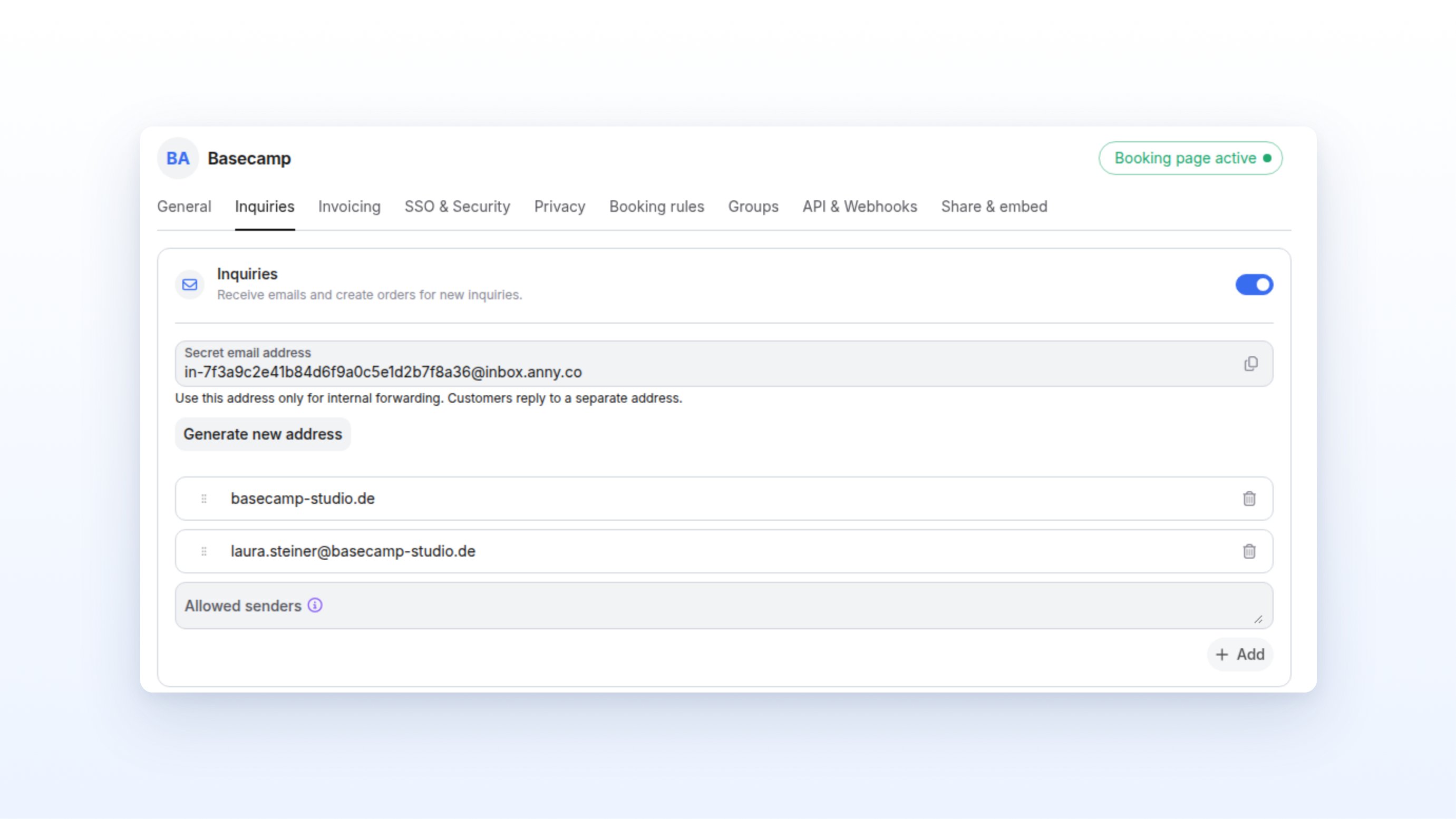
In the sidebar under Account, open Settings and switch to the Inquiries tab.You see an explanation in three steps: Forward, Capture, Reply.
Turn on email intake
Turn on the switch in the Inquiries card.anny shows your Secret email address.
Copy the address
Copy the address with the copy icon in the field.You can now enter it in your mailbox as a forwarding target.
Restrict senders (optional)
Under Allowed senders, enter the email addresses or domains anny should accept emails from, for example person@example.com or example.com. Click Add.From now on, anny only accepts emails from these senders.
Use the secret address only for internal forwarding and don’t share it with customers. Customers reply to a separate address that anny sets automatically.
Forwarding one at a time or with a forwarding rule
There are two ways to send emails to anny:
- Forward one at a time: You forward selected emails by hand.
- Forwarding rule: You set up a rule in your mailbox that, for example, automatically sends all emails to
inquiries@your-company.com to the secret address.
The difference shows when anny matches the customer. anny matches an email to an existing customer by the sender address or creates a new one. That only works if the email arrives as the original. If anny recognizes an email as forwarded by hand, for example by a subject starting with “Fwd:” or “FW:”, or as an automated message, the inquiry stays without a customer. Add one in the inquiry with Add customer.
Prefer a forwarding rule that passes on the original message. That way anny recognizes the sender and matches the inquiry to the right customer straight away.
What happens to a forwarded email
- Every new email becomes an inquiry with the status New. At first it shows the subject and text, then anny replaces them with a short summary in the Inquiry column.
- Your team is notified about the new inquiry.
- If the email names an unambiguous date with a resource and service, anny creates a booking proposal that occupies no capacity.
- When the customer later replies to an email from anny, anny adds the reply to the right inquiry. No new inquiry is created.
Generating a new address
If the secret address fell into the wrong hands or you receive spam, click Generate new address. The previous address stops working immediately. Update your forwarding rules afterwards. Customer replies to existing inquiries keep arriving.
When do I use this?
- Company events and room rentals: A “Private event” inquiry form asks for the date, number of guests and catering. You send a quote with reserved bookings.
- Existing inquiry mailbox: A forwarding rule sends every email to your inquiry address to anny. Your team works through them in the Needs action view.
- Inquiries by phone: Your voice assistant takes inquiries with an inquiry form that is available For AI assistants.
- Calls in the team: After a phone call, you enter the inquiry with New and send the quote later.
FAQ
Is an inquiry already a booking?
No. An inquiry is a draft order, and its bookings start out as proposals. They are only firm once you confirm them or click Accept for customer under Sent quotes.
Do booking proposals block my calendar?
No. Transparent bookings and proposals occupy no capacity. They only block the slot once you confirm them or turn on Reserve bookings when sending the quote.
Can I change the inquiry status myself?
You can Mark as done, Archive or Unarchive an inquiry. anny sets all other statuses automatically.
How does the customer accept a quote?
They open the link in the quote email and sign online. Afterwards, you confirm the proposed bookings. If they agree by phone or email, click Accept for customer under Sent quotes. This confirms the bookings right away.
What happens when a quote expires?
The customer can no longer sign it and the inquiry moves to Quote expired. If you chose Expire bookings when the quote expires, the bookings free their slots. You can Extend validity or send a new quote.
Do customers get a confirmation when they submit an inquiry form?
After submitting, they see the message Inquiry received on the page. When an email address is available, anny also sends a confirmation email. You set the text on the form under Confirmation email as Custom confirmation message. Leave the field empty and anny uses the standard confirmation. You write your own first reply in the inquiry’s activity log.
Who on the team is notified about new inquiries?
Everyone who has Customer messages turned on in their notifications. This covers new inquiries as well as customer replies by email.
Do customers see the secret email address?
No. anny sends replies to customers with its own reply address. You only need the secret address for forwarding from your mailbox.
Troubleshooting
A forwarded email has no customer
anny doesn’t match a customer if it recognizes the email as forwarded by hand or automated, for example by a subject starting with “Fwd:” or “FW:”. Click Add customer in the Summary. For future emails, a forwarding rule that passes on the original message helps.
A forwarded email doesn't arrive
Check that intake is turned on in the Inquiries tab and that you use the current address. If you entered Allowed senders, the forwarding address or its domain must be on the list. If a new address was generated, update your forwarding rule.
I can't mark the inquiry as done
Some bookings are still open. Accept or reject requested bookings, and confirm or remove outstanding transparent bookings. The Inquiry status field tells you what is missing.
The Send as quote button is missing or disabled
The quote needs an invoice total above 0 and an email address for the customer. Without an address you see the hint “Add an email address in the customer section to send the quote.” You also need permission to edit orders.
The inquiry form doesn't accept inquiries
Check that the form has at least one question group, that it is saved, and that your organization is live. For voice and chat assistants, For AI assistants under AI submissions must be on.
I don't see the Inquiries tab in the settings
Only people who may edit the organization can set up email intake. Ask someone with admin rights to set it up.